

- Extended Profile
- CRITERION 1
- CRITERION 2
- CRITERION 3
- CRITERION 4
- CRITERION 5
- CRITERION 6
- CRITERION 7
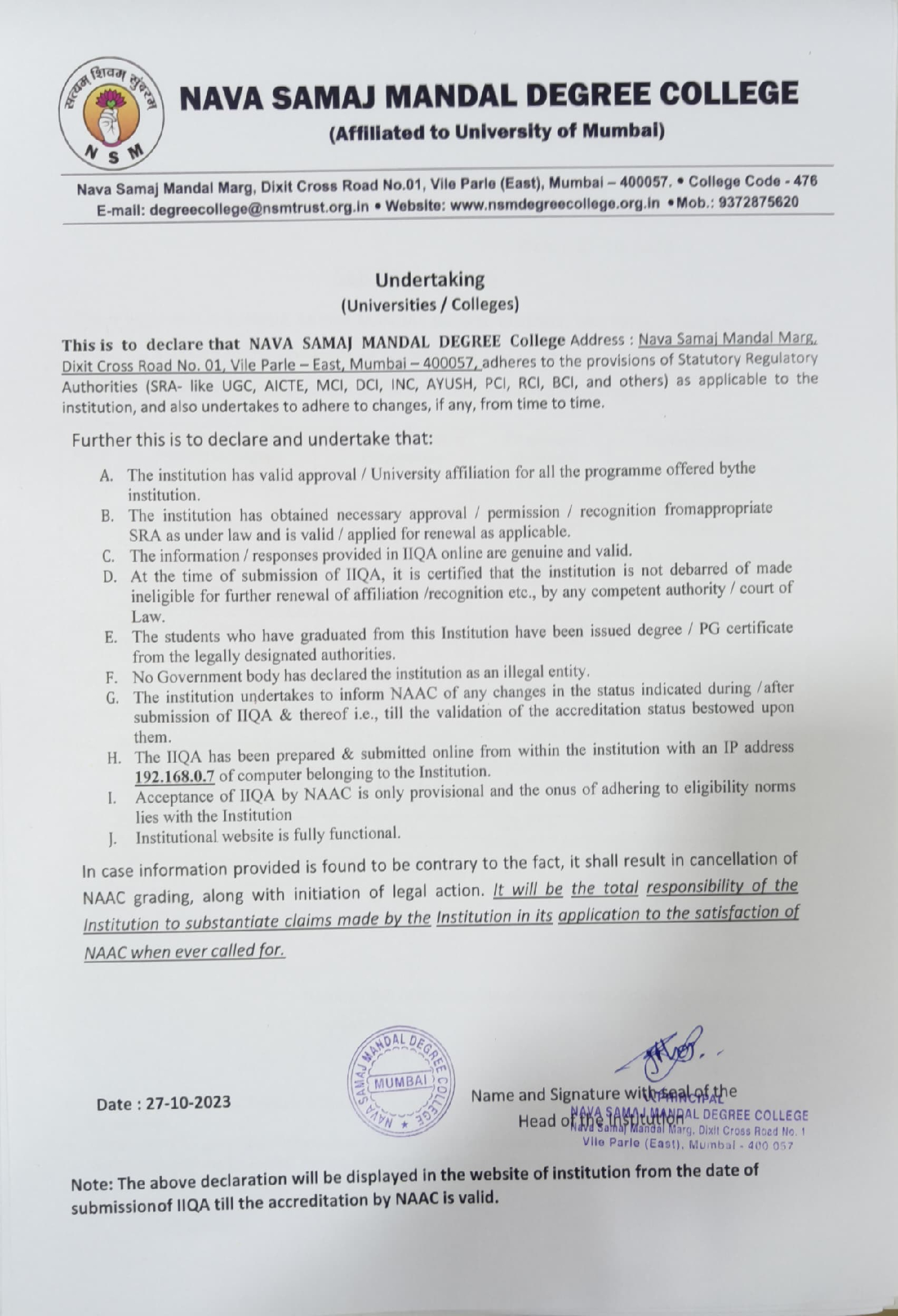
- UNDERTAKING
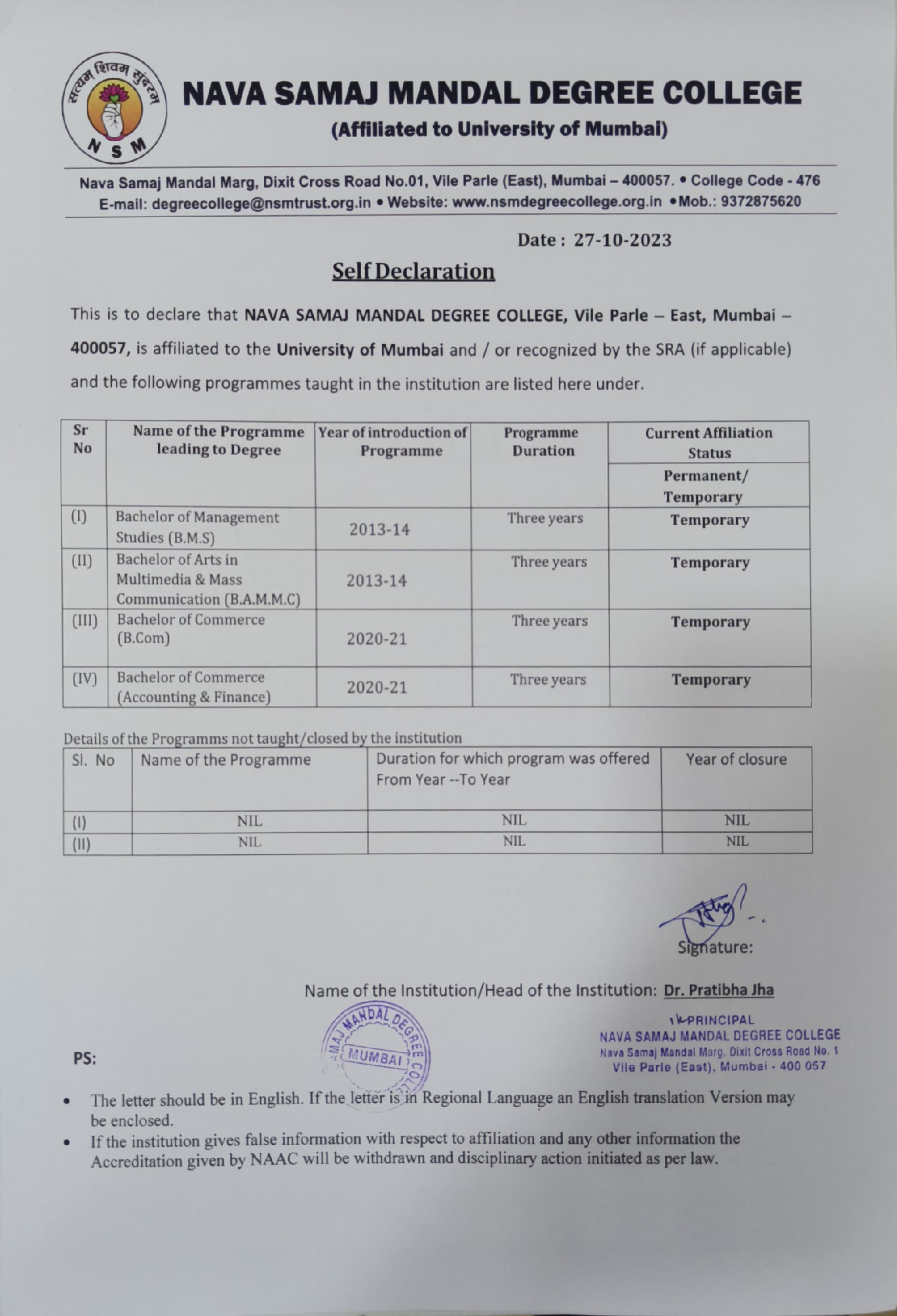
- SELF DECLARATION
- SSR
- DVV Clarification
- Best Practices
- Institutional Distinctiveness
- Code of Conduct
- HR Policy
- Capacity Building and Skill Enhancement
- Stakeholder Feedback
- Annual Report
Extended Profile |
||
| Metric No. | Parameter | Link |
| 1.1 | Number of students year wise during the last five years | VIEW |
| 2.1 & 2.2 | Number of full time teachers during the last five years (Without repeat count) | VIEW |
| 3.1 | Expenditure excluding salary component year wise during the last five years (INR in lakhs) | VIEW |
| CRITERION 1 – Curricular Aspects (100) | ||
| Key Indicator – 1.1 Curricular Planning and Implementation (20) | ||
| Metric No. | Description | Link |
| 1.1.1 QlM | The Institution ensures effective curriculum planning and delivery through a well – planned and documented process including Academic calendar and conduct of continuous internal Assessment. Write description in a maximum of 500 words | VIEW |
| Key Indicator – 1.2 Academic Flexibility (30) | ||
| Metric No. | Description | Link |
|
1.2.1
|
Number of Certificate/Value added courses offered and online courses of MOOCs, SWAYAM, NPTEL etc. where the students of the institution have enrolled and successfully completed during the last five years) 1.2.1.1: Number of Certificate/Value added courses offered and online courses of MOOCs, SWAYAM, NPTEL etc. where the students of the institution have enrolled and successfully completed during the last five years: _____ |
|
|
1.2.2
|
Percentage of students enrolled in Certificate/ Value added courses and also completed online courses of MOOCs, SWAYAM, NPTEL etc. 1.2.2.1. Number of students enrolled in Certificate/ Value added courses and also completed online courses of MOOCs, SWAYAM, NPTEL etc. as against the total number of students during the last five years |
|
| Key Indicator – 1.3 Curriculum Enrichment (30) | ||
| Metric No. | Description | Link |
| 1.3.1 QlM | Institution integrates crosscutting issues relevant to Professional Ethics, Gender, Human Values, Environment and Sustainability in transacting the Curriculum Write description in a maximum of 500 words | VIEW |
|
1.3.2.
|
Percentage of students undertaking projects work / field work / internships (Data for the latest completed academic year) 1.3.2.1. Number of students undertaking Project work/ field work/ internships |
|
| Key Indicator – 1.4 Feedback System (20) | ||
| Metric No. | Description | Link |
| 1.4.1 | Institution obtains feedback on the academic performance and ambience of the institution from various stakeholders, such as Students, Teachers, Employers, Alumni etc. and action taken report on the feedback is made available on institutional website | VIEW |
| CRITERION 2 – Teaching, Learning and Evaluation (350) | ||
| Key Indicator – 2.1 Student Enrolment and Profile (40) | ||
| Metric No. | Description | Link |
| 2.1.1 | Enrolment Percentage | VIEW |
| 2.1.2 | Percentage of seats filled against seats reserved for various categories (SC, ST, OBC, Divyangjan, etc. as per applicable reservation policy during the last five years (Exclusive of supernumerary seats) | VIEW |
| Key Indicator – 2.2 Student Teacher Ratio (40) | ||
| Metric No. | Description | Link |
| 2.2.1 | Student – Full time Teacher Ratio (Data for the latest completed academic year) | VIEW |
| Key Indicator – 2.3 Teaching – Learning Process (40) | ||
| Metric No. | Description | Link |
|
2.3.1
QlM |
Student centric methods, such as experiential learning, participative learning and problem solving methodologies are used for enhancing learning experiences and teachers use ICT- enabled tools including online resources for effective teaching and learning process. Write description in a maximum of 500 words
|
|
| Key Indicator – 2.4 Teacher Profile and Quality (40) | ||
| Metric No. | Description | Link |
|
2.4.1
|
Percentage of full-time teachers against sanctioned posts during the last five years 2.4.1.1 Number of Sanctioned post / required positions for teaching staff/ full time teachers year wise during last five years |
|
|
2.4.2
|
Percentage of full time teachers with NET/SET/SLET/ Ph. D. / D.M. / M.Ch. / D.N.B Superspeciality / D.Sc. / D.Litt. during the last five years (consider only highest degree for count) 2.4.2.1 Number of full time teachers with NET/SET/SLET/ Ph. D. / D.M. / M.Ch. / D.N.B Superspeciality / D.Sc. / D.Litt. year wise during the last five years |
|
| Key Indicator – 2.5 Evaluation Process and Reforms (40) | ||
| Metric No. | Description | Link |
|
2.5.1
QlM |
Mechanism of Internal / External assessment is transparent and the grievance redressal system is time – bound and efficient. Write description in a maximum of 500 words
|
|
| Key Indicator – 2.6 Student Performance and Learning Outcome (90) | ||
| Metric No. | Description | Link |
|
2.6.1
QIM |
Programme Outcomes(POs) and Course Outcomes(COs) for all programmes offered by the institution are stated and displayed on website and attainment of POs and COs are evaluated Write description in the maximum of 500
|
|
|
2.6.2
QlM |
Attainment of POs and COs are evaluated. Explain with evidence in a maximum of 500 words
|
|
|
2.6.3
|
Pass percentage of students during last five years. 2.6.3.1 Number of final year students who passed the university examination year wise during the last five years 2.6.3.2. Number of final year students who appeared for the university examination year wise during the last five years |
|
|
CRITERION 3
|
||
| Key Indicator – 3.1 Grants | ||
| Metric No. | Description | Link |
| 3.1.1 | Grants received from Government and Non-governmental agencies for research projects/ endowments in the institution during the last five years (INR in Lakhs) | VIEW |
| Key Indicator – 3.2 Innovation Ecosystem (15) | ||
| Metric No. | Description | Link |
|
3.2.1
QlM |
Institution has created an Ecosystem for Innovations and has initiatives for creation and transfer of knowledge (patents filed, published, incubation center facilities in HEI to be considered) Write description in a maximum of 500 words
|
|
| 3.2.2 | Number of Workshops/Seminars/Conferences including on Research Methodology, Intellectual Property Rights (IPR) and Entrepreneurship conducted during the last five years | VIEW |
| Key Indicator – 3.3 Research Publication and Awards (25) | ||
| Metric No. | Description | Link |
| 3.3.1 | Number of research papers published per teacher in the journals notified on UGC care list during the last five years. | VIEW |
| 3.3.2 | Number of books and chapters in edited volumes/ books published and papers published in national and International conference proceedings per teacher during the last five years | VIEW |
| Key Indicator – 3.4 Extension Activities (40) | ||
| Metric No. | Description | Link |
|
3.4.1
QlM |
Extension Activities are carried out in the neighbourhood community, sensitizing students to social issues, for their holistic development, and impact thereof during the last five years. Write description in a maximum of 500 words
|
|
|
3.4.2
QlM |
Awards and recognitions received for extension activities from government/ government recognized bodies Write description in a maximum of 500 words
|
|
| 3.4.3 | Number of extension and outreach programs conducted by the Institution through NSS/NCC/ Red cross/ YRC etc, (including the programmes such as Swachh Bharat, AIDS awareness, Gender issues etc and/or those organized in collaboration with industry, community and NGOs) during the last five years. | VIEW |
| Key Indicator – 3.5 Collaboration (20) | ||
| Metric No. | Description | Link |
| 3.5.1 | The number of MoUs, Collaborations/ Linkages for faculty exchange, Internship, Field trip, On-the-job training, research and other academic activities during the last five years | VIEW |
|
CRITERION 4 – Infrastructure and learning Resources (100)
|
||
| Key Indicator – 4.1 Physical Facilities (30) | ||
| Metric No. | Description | Link |
| 4.1.1 QlM |
The Institution has adequate infrastructure and other facilities for a. teaching – learning, viz., classrooms, laboratories, computing equipment etc b. ICT – enabled facilities such as smart class, LMS etc. Facilities for Cultural and sports activities, yoga centre, games (indoor and outdoor), Gymnasium, auditorium etc Describe the adequacy of facilities in maximum of 500 words. |
VIEW |
|
4.1.2
QnM |
Percentage of expenditure for infrastructure development and augmentation excluding salary during the last five years | |
| 4.1.2.1: Expenditure for infrastructure development and augmentation, excluding salary year wise during last five years (INR in lakhs) | ||
| Key Indicator – 4.2 Library as a learning Resources (20) | ||
| Metric No. | Description | Link |
| 4.2.1 QlM |
Library is automated with digital facilities using Integrated Library Management System (ILMS), adequate subscriptions to e-resources and journals are made. The library is optimally used by the faculty and students. Write description in a maximum of 500 words | VIEW |
| Key Indicator – 4.3 IT Infrastructure (30) | ||
| Metric No. | Description | Link |
| 4.3.1 QlM |
Institution frequently updates its IT facilities and provides sufficient bandwidth for internet connection Describe IT facilities including Wi-Fi with date and nature of updation, available internet bandwidth within a maximum of 500 words |
VIEW |
|
4.3.2
QnM |
Student – Computer Ratio ( Data for the latest completed academic year) | |
| 4.3.2.1 Number of Computers available for students usage during the latest completed academic year | ||
| Key Indicator – 4.4 Maintenance of Campus Infrastructure (20) | ||
| Metric No. | Description | Link |
|
4.4.1
QnM |
Percentage expenditure incurred on maintenance of physical facilities and academic support facilities excluding salary component, during the last five years | |
| 4.4.1.1 Expenditure incurred on maintenance of physical facilities and academic support facilities excluding salary component year wise during last five years (INR in lakhs) | ||
|
CRITERION 5 – Student Support and Progression (140)
|
||
| Key Indicator – 5.1 Student Support (50) | ||
| Metric No. | Description | Link |
|
5.1.1
QnM |
Percentage of students benefited by scholarships and freeships provided by the institution, government and non-government bodies, industries, individuals, philanthropists during the last five years. |
|
| 5.1.1.1. Number of students benefited by scholarships and freeships provided by the institution, Government and non-government bodies, industries, individuals, philanthropists during the last five years. | ||
| 5.1.2 QnM |
Following capacity development and skills enhancement activities are organized for improving students’ capability 1. Soft skills |
VIEW |
|
5.1.3
QnM |
Percentage of students benefitted by guidance for competitive examinations and career counseling offered by the Institution during the last five years. | |
| 5.1.3.1 Number of students benefitted by guidance for competitive examinations and career counseling offered by the institution year wise during last five years | ||
| 5.1.4 QnM |
The institution adopts the following for redressal of student grievances including sexual harassment and ragging cases 1. Implementation of guidelines of statutory/regulatory bodies 2. Organisation wide awareness and undertakings on policies with zero tolerance 3. Mechanisms for submission of online/offline students’ grievances 4. Timely redressal of the grievances through appropriate committees |
VIEW |
| Key Indicator – 5.2 Student Progression (30) | ||
| Metric No. | Description | Link |
|
5.2.1
QnM |
Percentage of placement of outgoing students and students progressing to higher education during the last five years. |
|
| 5.2.1.1 Number of outgoing students placed and / or progressed to higher education year wise during the last five years. | ||
| 5.2.1.2. Number of outgoing students year wise during the last five years. | ||
| 5.2.2 QnM |
Percentage of students qualifying in state/national/ international level examinations during the last five years. (eg: IIT/JAM/NET/SLET/GATE/GMAT/GPAT/CLAT/CAT/GRE/TOEFL/ IELTS/Civil Services/State government examinations etc.) | VIEW |
| Key Indicator – 5.3 Student Participation and Activities (50) | ||
| Metric No. | Description | Link |
| 5.3.1 QnM |
Number of awards / medals for outstanding performance in sports / cultural actives at University / State / National / International level (award for a team event should be counted as one ) during the last five years. | VIEW |
| 5.3.2 | Average number of sports and cultural programs in which students of the Institution participated during last five years. (organised by the institution/other institutions) | VIEW |
| Key Indicator – 5.4 Alumni Engagement (10) | ||
| Metric No. | Description | Link |
| 5.4.1 QlM |
There is a registered Alumni Association that contributes significantly to the development of the institution through financial and / or other support services | VIEW |
| CRITERION 6 – Governance, Leadership and Management (100) | ||
| Key Indicator – 6.1 Institutional Vision and Leadership (10) | ||
| Metric No. | Description | Link |
| 6.1.1 QlM |
The governance and leadership is in accordance with vision and mission of the institution and it is visible in various institutional practices such as decentralization and participation in the institutional governance | VIEW |
| Key Indicator – 6.2 Strategy Development and Deployment (10) | ||
| Metric No. | Description | Link |
| 6.2.1 QlM |
The functioning of the institutional bodies is effective and efficient as visible from policies, administrative setup, appointment and service rules, procedures, deployment of institutional Strategic/ perspective/development plan etc | VIEW |
| 6.2.2 | Implementation of e-governance in areas of operation 1. Administration 2. Finance and Accounts 3. Student Admission and Support 4. Examination | VIEW |
| Key Indicator – 6.3 Faculty Empowerment Strategies (35) | ||
| Metric No. | Description | Link |
|
6.3.1 QlM |
The institution has effective welfare measures and Performance Appraisal System for teaching and non-teaching staff
|
|
| 6.3.2 |
Percentage of teachers provided with financial support to attend conferences/workshops and towards membership fee of professional bodies during the last five years. 6.3.2.1. Number of teachers provided with financial support to attend conferences/workshops and towards membership fee of professional bodies year wise during the last five years |
VIEW |
|
6.3.3
|
Percentage of teaching and non-teaching staff participating in Faculty development Programmes (FDP), professional development /administrative training programs during the last five years. | |
| 6.3.3.1.Total number of teaching and non-teaching staff participating in Faculty development Programmes (FDP), professional development /administrative training programs during the last five years. | ||
| 6.3.3.2 Number of non-teaching staff year wise during the last five years | ||
| Key Indicator – 6.4 Financial Management and Resource Mobilization (15) | ||
| Metric No. | Description | Link |
| 6.4.1 QlM |
Institution has strategies for mobilization and optimal utilization of resources and funds from various sources (government/ nongovernment organizations) and it conducts financial audits regularly (internal and external) | VIEW |
| Key Indicator – 6.5 Internal Quality Assurance System (30) | ||
| Metric No. | Description | Link |
| 6.5.1 QlM |
Internal Quality Assurance Cell (IQAC) has contributed significantly for institutionalizing the quality assurance strategies and processes. It reviews teaching learning process, structures & methodologies of operations and learning outcomes at periodic intervals and records the incremental improvement in various activities | VIEW |
| 6.5.2 | Quality assurance initiatives of the institution include: 1. Regular meeting of Internal Quality Assurance Cell (IQAC); Feedback collected, analyzed and used for Improvements 2. Collaborative quality initiatives with other institution(s)/membership of international networks 3. Participation in NIRF 4. any other quality audit/accreditation recognized by state, national or international agencies such as NAAC, NBA,ISO Certification etc | VIEW |
|
CRITERION 7 – Institutional Values and Best Practices (100)
|
||
| Key Indicator – 7.1 Institutional Values and Social Responsibilities (50) | ||
| Metric No. | Description | Link |
| 7.1.1 QlM |
Institution has initiated the Gender Audit and measures for the promotion of gender equity during the last five years. Describe the gender equity & sensitization in curricular and co-curricular activities, facilities for women on campus etc., |
VIEW |
| 7.1.2 QnM |
The Institution has facilities and initiatives for 1. Alternate sources of energy and energy conservation measures 2. Management of the various types of degradable and non degradable waste 3. Water Conservation 4. Green campus initiatives 5. Disabled – friendly, barrier free environment |
VIEW |
| 7.1.3 QnM |
Quality audits on environment and energy regularly undertaken by the Institution The institutional environment and energy initiatives are confirmed through the following 1. Green audit / Environment audit 2. Energy audit 3. Clean and green campus initiatives 4. Beyond the campus environmental promotion sustainability activities |
VIEW |
| 7.1.4 QlM |
Describe the Institutional efforts/initiatives in providing an inclusive environment i.e., tolerance and harmony towards cultural, regional, linguistic, communal socioeconomic diversity and Sensitization of students and employees to the constitutional obligations: values, rights, duties and responsibilities of citizens. | VIEW |
| Key Indicator – 7.2 Best Practices (30) | ||
| Metric No. | Description | Link |
| 7.2.1 QlM |
Describe two best practices successfully implemented by the Institution as per NAAC format provided in the Manual | VIEW |
| Key Indicator – 7.3 Institutional Distinctiveness (20) | ||
| Metric No. | Description | Link |
| 7.3.1 QlM |
Portray the performance of the Institution in one area distinctive to its priority and thrust within 1000 words | VIEW |
Extended Profile |
||
| Metric No. | Description | Link |
| 1.1 | Number of students year wise during the last five years | VIEW |
| 2.1 | Number of full time teachers during the last five years (Without repeat count) | VIEW |
| 2.2 | Number of teaching staff / full time teachers year wise during the last five years | VIEW |
| 3.1 | Expenditure excluding salary component year wise during the last five years (INR in lakhs) | VIEW |
| Criteria 1 : Curricular Aspects | ||
| Metric ID | Deviations Details | Link |
| 1.2.1 | Number of Certificate / Value added courses offered and online courses of MOOCs, SWAYAM, NPTEL etc. (where the students of the institution have enrolled and successfully completed during the last five years) | VIEW |
| 1.2.2 | Percentage of students enrolled in Certificate / Value added courses and also completed online courses of MOOCs, SWAYAM, NPTEL etc. as against the total number of students during the last five years | VIEW |
| 1.3.2 | Percentage of students undertaking project work / field work / internships (Data for the latest completed academic year) | VIEW |
| 1.4.1 | Institution obtains feedback on the academic performance and ambience of the institution from various stakeholders, such as Students, Teachers, Employers, Alumni etc. and action taken report on the feedback is made available on institutional website | VIEW |
Criteria 2 : Teaching – Learning and Evaluation |
||
| Metric ID | Deviations Details | Link |
| 2.1.1 | Enrolment percentage 2.1.1.1. Number of seats filled year wise during last five years (Only first year admissions to be considered) 2.1.1.2. Number of sanctioned seats year wise during last five years |
VIEW |
| 2.1.2 |
Percentage of seats filled against reserved categories (SC, ST, OBC etc.) as per applicable reservation policy for the first year admission during the last five years 2.1.2.1. Number of actual students admitted from the reserved categories year wise during last five years (Exclusive of supernumerary seats) 2.1.2.2. Number of seats earmarked for reserved category as per GOI/ State Govt rule year wise during the last five years |
VIEW |
| 2.2.1 | Student – Full time Teacher Ratio (Data for the latest completed academic year) | VIEW |
| 2.4.1 | Percentage of full-time teachers against sanctioned posts during the last five years | VIEW |
| 2.4.2 | Percentage of full time teachers with NET / SET / SLET / Ph. D./ D.Sc. / D.Litt. / L.L.D. during the last five years (consider only highest degree for count) | VIEW |
| 2.6.3 | Pass percentage of Students during last five years (excluding backlog students) | VIEW |
Criteria 3 : Research, Innovations and Extension |
||
| Metric ID | Deviations Details | Link |
| 3.1.1 | Grants received from Government and non-governmental agencies for research projects / endowments in the institution during the last five years (INR in Lakhs) | VIEW |
| 3.2.2 | Number of workshops / seminars / conferences including on Research Methodology, Intellectual Property Rights (IPR) and entrepreneurship conducted during the last five years | VIEW |
| 3.3.1 | Number of research papers published per teacher in the Journals notified on UGC care list during the last five years | VIEW |
| 3.3.2 | Number of books and chapters in edited volumes / books published and papers published in national/ international conference proceedings per teacher during last five years | VIEW |
| 3.4.3 | Number of extension and outreach programs conducted by the institution through organized forums including NSS / NCC with involvement of community during the last five years | VIEW |
| 3.5.1 | Number of functional MoUs/linkages with institutions / industries in India and abroad for internship, on-the-job training, project work, student / faculty exchange and collaborative research during the last five years | VIEW |
Criteria 4 : Infrastructure and Learning Resources |
||
| Metric ID | Deviations Details | Link |
| 4.1.2 | Percentage of expenditure for infrastructure development and augmentation excluding salary during the last five years | VIEW |
| 4.3.2 | Student – Computer ratio (Data for the latest completed academic year) | VIEW |
| 4.4.1 | Percentage expenditure incurred on maintenance of physical facilities and academic support facilities excluding salary component, during the last five years | VIEW |
Criteria 5 : Student Support and Progression |
||
| Metric ID | Deviations Details | Link |
| 5.1.1 | Percentage of students benefited by scholarships and freeships provided by the institution, government and non-government bodies, industries, individuals, philanthropists during the last five years | VIEW |
| 5.1.2 | Following capacity development and skills enhancement activities are organised for improving students’ capability 1. Soft skills 2. Language and communication skills 3. Life skills (Yoga, physical fitness, health and hygiene) 4. ICT / computing skills |
VIEW |
| 5.1.3 | Percentage of students benefitted by guidance for competitive examinations and career counseling offered by the Institution during the last five years | VIEW |
| 5.1.4 | The institution adopts the following for redressal of student grievances including sexual harassment and ragging cases 1. Implementation of guidelines of statutory / regulatory bodies 2. Organisation wide awareness and undertakings on policies with zero tolerance 3. Mechanisms for submission of online/offline students’ grievances 4. Timely redressal of the grievances through appropriate committees |
VIEW |
| 5.2.1 | Percentage of placement of outgoing students and students progressing to higher education during the last five years | VIEW |
| 5.2.2 | Percentage of students qualifying in state / national / international level examinations during the last five years | VIEW |
| 5.3.1 | Number of awards/medals for outstanding performance in sports / cultural activities at University / state / national / international level (award for a team event should be counted as one) during the last five years | VIEW |
| 5.3.2 | Average number of sports and cultural programs in which students of the Institution participated during last five years (organised by the institution / other institutions) | VIEW |
Criteria 6 : Governance, Leadership and Management |
||
| Metric ID | Deviations Details | Link |
| 6.2.2 | Institution implements e-governance in its operations 1. Administration 2. Finance and Accounts 3. Student Admission and Support 4. Examination |
VIEW |
| 6.3.2 | Percentage of teachers provided with financial support to attend conferences / workshops and towards membership fee of professional bodies during the last five years | VIEW |
| 6.3.3 | Percentage of teaching and non-teaching staff participating in Faculty development Programmes (FDP), Management Development Programmes (MDPs) professional development / administrative training programs during the last five years | VIEW |
| 6.5.2 | Quality assurance initiatives of the institution include: 1. Regular meeting of Internal Quality Assurance Cell (IQAC); quality improvement initiatives identified and implemented 2. Academic and Administrative Audit (AAA) and follow-up action taken 3. Collaborative quality initiatives with other institution(s) 4. Participation in NIRF and other recognized rankings 5. Any other quality audit/accreditation recognized by state, national or international agencies such as NAAC, NBA etc. |
VIEW |
Criteria 7 : Institutional Values and Best Practices |
||
| Metric ID | Deviations Details | Link |
| 7.1.2 | The Institution has facilities and initiatives for 1. Alternate sources of energy and energy conservation measures 2. Management of the various types of degradable and non-degradable waste 3. Water conservation 4. Green campus initiatives 5. Disabled-friendly, barrier free environment |
VIEW |
| 7.1.3 | Quality audits on environment and energy regularly undertaken by the Institution. The institutional environment and energy initiatives are confirmed through the following 1. Green audit / Environment audit 2. Energy audit 3. Clean and green campus initiatives 4. Beyond the campus environmental promotion activities |
VIEW |
BEST PRACTICES
Title of the Practice: Staff welfare measures and health Insurance for faculty and students
Objectives:
- To provide health insurance for students and staff members.
- To reduce the financial burden of parents as well as institutions.
- To provide affordable and safe medical coverage and care to staff and students.
- To ensure good health and well-being.
- To provide and ensure both students as well as the faculties receive proper coverage.
Context:
The object of the scheme is to lessen the financial burden on the parents of the students during hospitalization on account of illness or injury during their course of study and also to help faculty members by giving proper medical coverage and care.
Practice:
The institution believes that giving priority and preference to the welfare of both staff and students will bring prosperity to the institution and will help the beneficiaries to lessen their concern about their financial burden
Students: A sum of Rs. 20/- is collected from each student at the time of admission.
Staff: Each staff member is contributed a sum of Rs. 500/ to the insurance by the management every month.
Staff welfare measures
- Financial assistance is provided for all the faculties attending FDPs, Workshops, and professional and administrative development programs, outside St. Thomas College of arts and science along with on-duty (OD) within India.
- The institution ensures that no faculties have financial barriers in terms of professional growth and thus financial assistance will be provided for faculties in book publishing.
- The institution encourages staff members to get involved in professional bodies thus we provide financial support towards membership fees of professional bodies.
- In terms of promoting research and integrity, on-duty will be provided for attending programs and PhD research work.
- Faculties can avail the eligible vacation for his/her marriage or medical treatment.
- Faculties can avail of marriage allowance as per the college norms.
- Petty loans (No interest) are provided to the faculties who need financial support from the management
- Employee Provident Fund (EPF) – a popular welfare/saving scheme by the EPFO, according to which a certain amount is deducted from the salary and the management too contributes to the money deposited.
Evidence of success: Over the course of the last five years two staff members and four students have availed benefits of the scheme.
Problem encountered:
The problem encountered while implementing the scheme is that, the scheme covers most of the types of illness and injuries. The scheme can be availed in most of the hospitals and the institution is still upgrading the list for the betterment of the faculties.
Title of the Practice: Scholarships, Financial Aids and Endowment Prizes
Objectives:
- To ensure that the students are getting proper financial assistance from the institution.
- To ensure that every deserving student is provided with financial benefits like an endowment prize.
- To help the student community to give up their financial concerns, thus they could give ample time for studying and scoring better marks.
- To help the students to get access to quality education by making it both accessible and affordable too.
Context:
The global scenario today demands the learners of any institute to spend more money thus making education a costly and valuable thing to obtain.
Practice:
St. Thomas College of arts and science is known for helping students who seek financial aid in order to complete their education. To help those students institute, apart from guiding them to get government-provided scholarships like Adi Dravidar and Tribal welfare, and MUFES (Madras University Free Education scheme), the institution also provides two other non – governmental scholarships namely Zachariah Mar Dionysius Scholarship and St. Thomas Scholarship.
Many students in the global educational scenario have seen students leave college with massive student loan burdens. Students like them have a limited education as they have the prospect of repaying all of the money they have borrowed for the sake of education. It also puts a great deal of pressure on both the students as well as the parents to acquire a huge amount of money within their limitations. That is the reason why, even if the students wanted to, most of them are unable to pursue occupations that do not pay well at the entry level. A scholarship, on the other hand, is free money that permits students like them, mainly the students of first graduates to pursue their aspirations and follow their dream of completing a degree by reducing the financial barrier, it assists them in achieving their academic and career goals.
Evidence of success:
The institution has enabled the students to get access to a degree program making it affordable so that they have no financial concerns about paying back like an educational loan. Many of the students of this prestigious institution have availed of the scholarships either from the Government or the scholarship that has been provided by the institution.
The institution believes in catering to the needs of rural society because college students from rural backgrounds to are getting admitted to college. Students get an education at a nominal fee of a very low cost, for this purpose institutions are taking into consideration the students who need financial assistance by providing them with scholarships. Apart from providing Scholarships, colleges also give endowment prizes to deserving students every year.
Problem encountered:
The problem encountered by the institution is that a large number of students apply for the scholarship and the funds are limited, thus the institution is trying to get more funds for the betterment of the students. Apart from this, fund resource mobilization has been one of the key challenges for the management to provide the requisite scholarships.
Institutional Distinctiveness
Title: Outreach programs
The outreach programs of St. Thomas college of arts and science aims to help, uplift, and support the students deprived of certain services and rights. It involves giving learning, social planning, health support, and other projects for their welfare.
01. Cleanliness Drives
- The institution believes that cleanliness is the most important thing for both physical well-being and a healthy environment, and students should be the real ambassadors of this cleanliness. The institution took various measures, camps, and campaigns to create awareness among the public. The students also took initiative to clean up the surroundings.
- Around forty volunteers from our institution took part in removing trash from the beach, which will ensure to retain of the beauty of the coastline and also will help us to maintain a healthy marine ecosystem. The team was equipped with all the necessary cleaning tools like gloves, rakes and sacks.
- Clean Campus always promotes Hygiene, it improves hygiene levels on campus and also helps to reduce the spread of diseases, thus maintaining a clean college environment sets a good example to students. Volunteers took initiative to clean the campus, they went to all the classes and briefed about the importance of cleanliness of the campus. They gave awareness to the students not to throw paper plates, water bottles, paper cups, tissues, and many unwanted things on campus. Around sixty students volunteered for the program.
- Chennai is a city of extreme water-related calamities year after year with deadly floods during the rainy season and severe droughts during summer. To ease the severity of the summer season, volunteers from our institution came up to clean a pond so to save water, as this will be a water resource then. Volunteers working more than three hours segregated plastic waste separately to dispose of it properly.
02. Health and Hygiene
- The institution organised eye check-up camps and the objective of this event was to spread awareness of eye disorders and eye ailments among the public. Students of our institution volunteered by issuing tokens among the public and for registration for eye check-up camps. The public who required eye care treatment were given the necessary treatment and medicines at the same camp.
- Covid -19 has affected the lifestyle of almost all the citizens of India, on the verge of another breakout, institutions decided and organised an awareness rally around Koyambedu to spread awareness about the importance of taking precautionary measures against COVID-19. Volunteers took initiative to make the public understand the importance of wearing a mask and also the importance of maintaining social distancing.
03. Camps
- The NSS unit and YRC jointly conducted a blood donation camp in our institution. Apart from organising a camp, volunteers also gave awareness about the importance of donating blood. Many students from our institution took part and donated blood.
- The health check-up camp was set up and was organised by the institution in a village named Kandigai. Around fifty of the elderly and many children benefitted from this camp. Volunteers from our college helped them by distributing medicines and helping the needy.
04. Awareness Programs
- The institution took part in a “Plastic Free Awareness Campaign” called Walk for plastic to inform and create awareness in the local communities about the ill effects of Plastic waste pollution on the Environment and Human health. The aim is to increase public understanding and shape community perceptions of the dangers of plastic pollution and available solutions.
- Over forty students from our institution took part in a cycle rally to spread
- awareness among people to save the girl child and highlight the inequalities faced by the girl child in society. Students took out the rally from the college campus to nearby villages spreading the message of the importance of saving the girl child with placards and slogans.
- In the present global scenario, fast food has become part of our life. Fast food chains offer the convenience of meals that are ready-to-eat, not to mention the affordable prices of the food, but this fast foods and junk foods will increase the possibilities of diseases and disorders. Our students with placards and slogans created awareness among the public about the disadvantages of having junk foods.
- Our students have volunteered and given awareness about the consequences of global warming and visited an eco-farm to learn more about the environment and saplings. Around 30 students from our institution benefitted from this visit, and they created awareness about what they have learnt.
- Traditional foods are those which are passed on through generations and are more hygienic in nature, but the present generation is not aware of those traditional foods and is behind in junk foods. To create awareness among the students, volunteers initiated an exhibition and they presented many varieties of food, food sources etc.
05. Societal concern
- Janitors are the people who work for society, and helping them with consideration is a huge thing to be done. Our students volunteered in helping them near our college campus by cleaning and segregating the waste in the surrounding.
- According to the government of India, it is mandatory to have an Aaadhar card and voter ID and is very difficult to make corrections when there is an error. Volunteers from our institution helped the needy to get the mistake corrected.
- S. Dinesh Kumar of BBA was appreciated for his humanitarian concern of returning the money (INR 20,000) that he found on the floor to its owner. This kind gesture of his was appreciated by the faculties and the Principal to motivate and inspire other institution students.
Concluding Remarks:
St. Thomas college of arts and science has emerged as a centre of excellence in arts and science through outreach programs and activities. Building purposive partnerships with the industry, bolstering its wherewithal continually and evolving innovative programmes consistent with changing times.
Soft Skills
Soft skills training is a type of training that focuses on developing “soft” skills, which are non-technical skills. Some soft skill topics include time management, stress management, relationship building, leadership, managerial development, sales training, negotiation techniques and customer service.
More Details…
Language Communication Skills
By learning a foreign language, you can understand ideas and thoughts that may be different from your own culture. You can learn customs and how people interact in a given society. Language helps preserve cultures, but it also allows us to learn about others and spread ideas quickly.
More Details…
Life Skills
Life skills are an add-on to the formal education that is provided. It leads to the smooth learning of the taught curriculum, promotes harmony, motivates teachers and induces discipline.
More Details…
ICT/COMPUTING SKILLS
The goal of STCAS is to provide students with access to contemporary ICT tools, train them in their use, and ensure that they are proficient in doing so. The hardware and software required to train them are updated on a regular basis.
To support interactive teaching methods, smart boards are being installed in classrooms. It gives the professors a chance to deliver the material that they teach.
More Details…